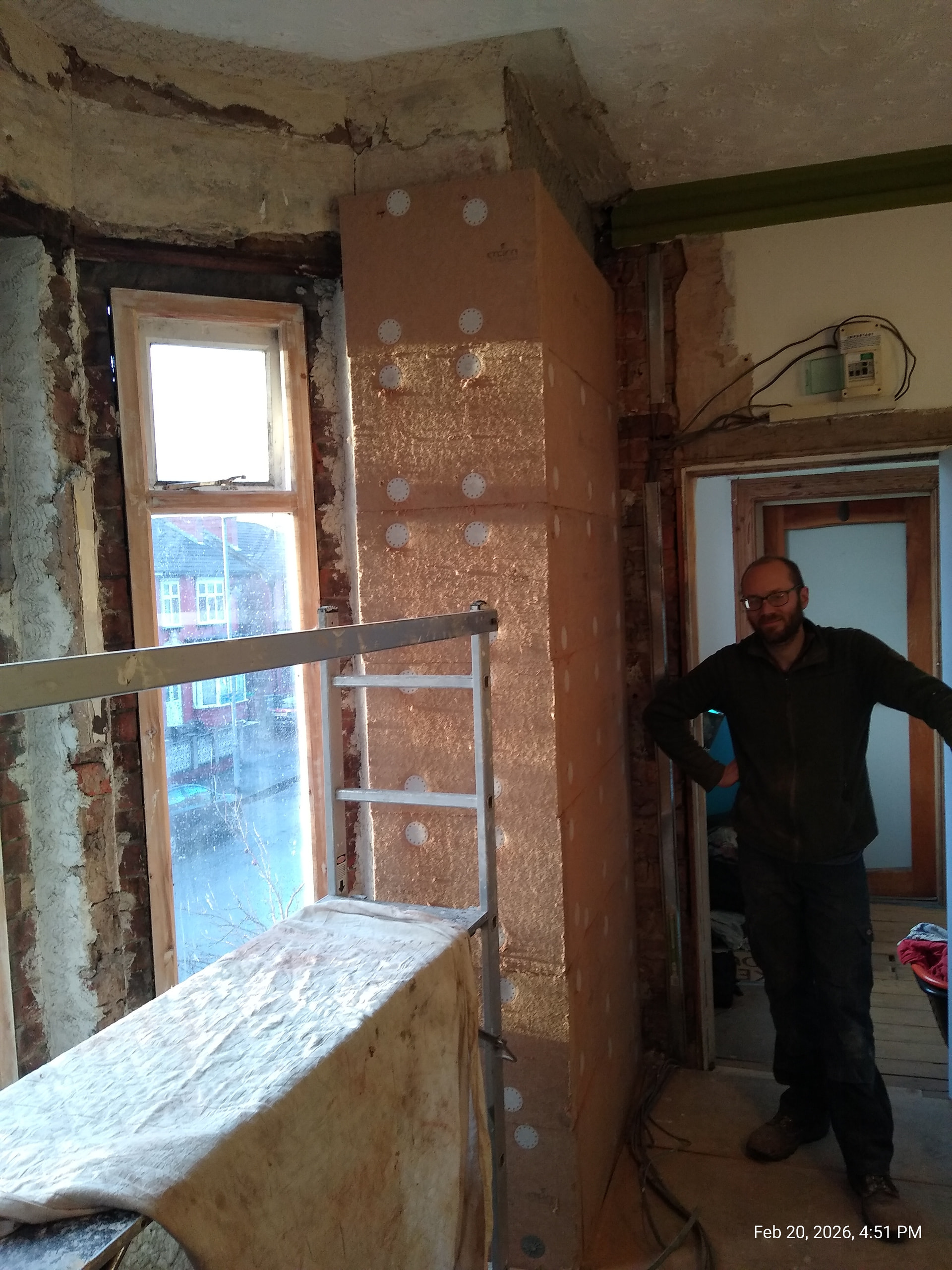
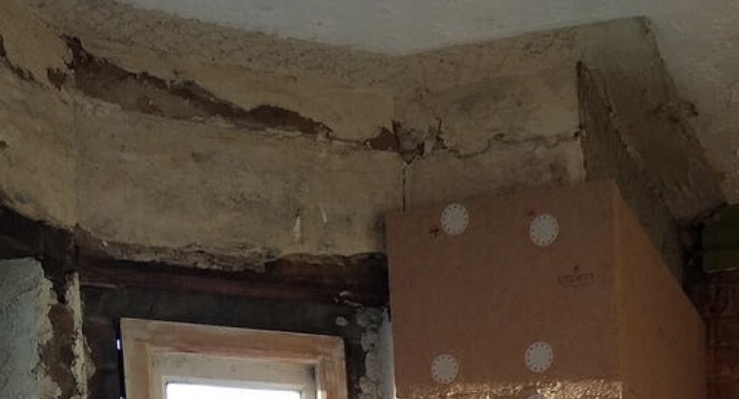
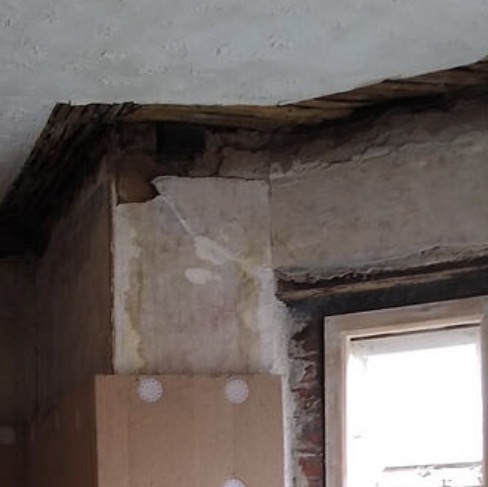
We’re doing internal wood fibre board insulation over lime plaster. Under the window is a wooden beam supporting some brickwork. We’ve decided to go for 60mm boards but have been advised to do just 40mm over the wooden beam. My understanding for this recommendation is to maintain a bit of warmth in the beam to reduce the risk of moisture condensing on a cold surface.
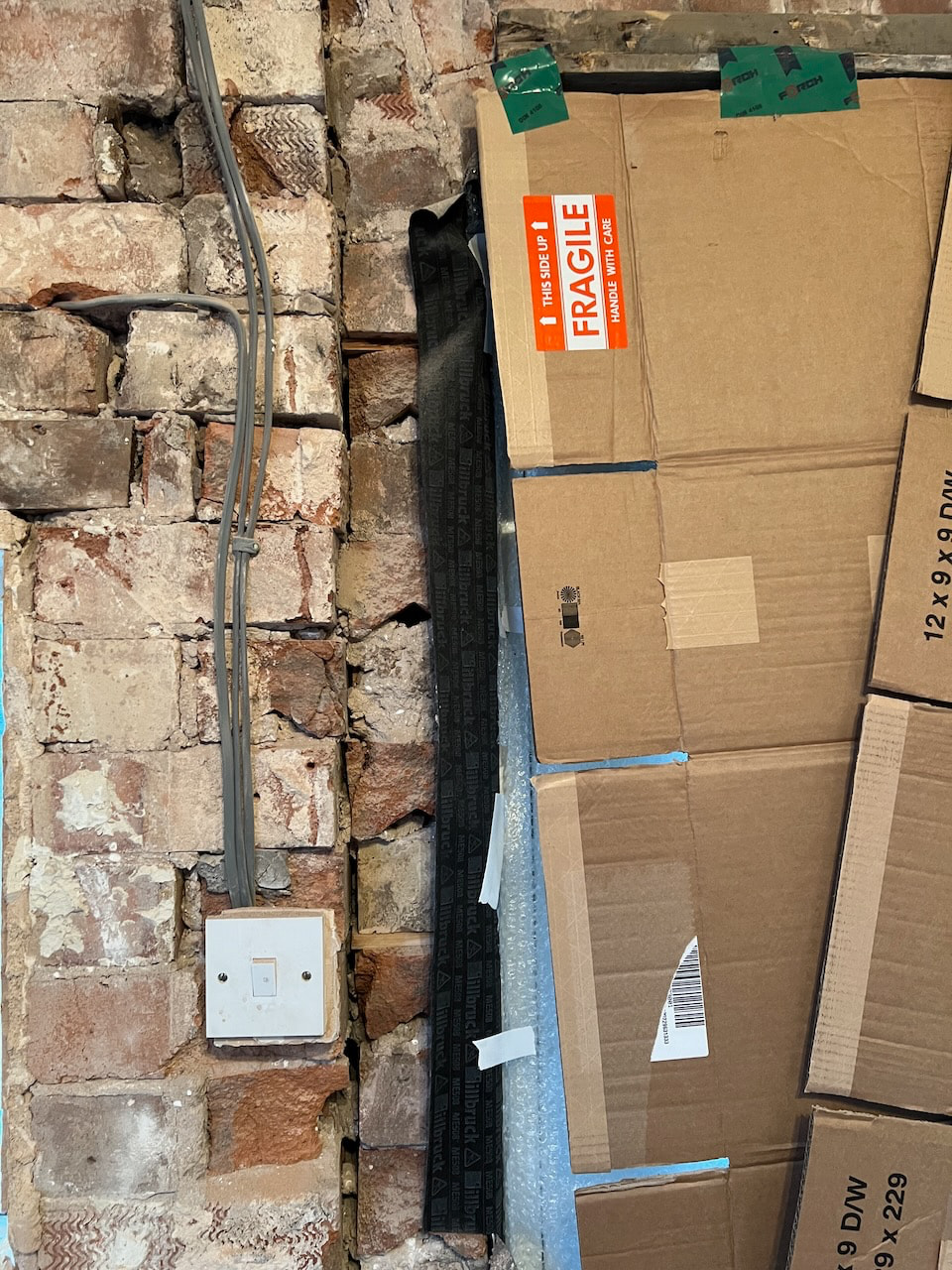
Additionally, the wall will be slightly further out from the beam so essentially to have a flat wall under window there will need to be a bit of a void around the beam.
What I’m thinking is that we could either put some battens on the beam and attach the wood fibre to those, meaning there’s some air around the beam or we could attach the wood fibre direct to the beam and then add battens to build out the wall in this area.
Do we have any thoughts on which of these options may be better from the perspective of avoiding moisture in the wooden beam? Essentially, do we want air around the beam or wood fibre straight on there?
I have no evidence to support it but my preference would be insulation direct to beam. This enables any moisture to wick away rather than rely on evaporation when (if) humidity drops. That does require you to have insulation that is capillary active.
What kind of woodfibre boards are you intending to use? The manufacturer instructions might help you out.
I think it is best not to leave an air gap and fix the woodfibre direct to the beam. That will allow it to wick any moisture out of the wood and transport it into the room. From my reading I noted that you should close any air gaps behind the woodfibre as much as possible. I have seen people recommending some lime bonding.
I also have a similar bay window (although my windows are not separated by brick piers) and fear that when I remove the old plaster there will also be a similar wooden beam underneath. (I had wooden lintels over every window and door) When was your house built?
That’s reassuring as I was leading in the same direction for similar reasons.
Planning to use rigid wood fibre boards that will be bonded to the walls with lime and then fixings added. My understanding is that these boards have some capillary action so can wick moisture. Plan is to finish with lime and then breathable paint so moisture can move as it needs to.
I think I will add some of the lime render we’re using for bonding to make sure there aren’t any gaps then find some fixings that are suitable for wood.
The house was built around 1880s from what I understand. The structure around this window is a bit complicated because the window below sits a bit further out so seemingly this beam is needed as well as the lintel above the window below.
I would like to learn a bit more about the options on the wood fibre boards and I get very geeky about these.
my initial information I got from the Wormersley website as they offer Warmshell wood fibre boards and sell the bonding and top coat as well. It does sound simpler than actually lime plastering from scratch. You might have looked at it already, but there is a lot of information here:
They also say not to have any air gaps behind the boards and it really makes sense as you really want the moisture wicking to work.
My initial plan is currently to insulate and plaster around my north facing front door, where I recently removed the older wet plaster and found a surprisingly uneven wall. Part cavity, part solid wall. I want to even out the wall thickness and obviously insulate the solid wall part. The wood fibre board seems a good solution, but I first need to level the wall.
It is worth noting that I am doing a dlground floor retrofit and I am planning to remove the old wet plaster around my bay window next and I expect I will need to do the same wood fibre and like plaster treatment there.
Having said that, I really have not much plastering experience and am just learning about lime. So I am still doing research and have signed up to some courses. And after deep diving into it, I am unsure if I want any gypsum plaster anywhere anymore (except the ceiling).
How about you? How come you are doing this work on the bay window now? Are you doing more around the house?
Some types of insulation are treated to reduce wicking/capillary action to protect them from excess moisture. You need to check your chosen insulation and potentially get a small amount of another product for under the windows and against any other wood that you uncover.
@Christian_Unger, I took have been learning a lot about lime recently and have naively decided it’s the answer to all the world’s problems.
It’s good to know about wormesleys as they seem based relatively close to Manchester. I’ve been looking at getting supplies from back to earth and unity lime who both seem good but are not based close enough for me to visit if needed.
Our wall has had a lot of levelling out and hole filling to do. I’ve been doing that with a simple sand and quicklime mix because it’s cheap. I visited eden hot lime mortar and I was lucky enough to get a wee demo on the mixing process.
I’m hoping to bond the boards on soon with a friend who has a lot more experience so I can report back what I learn.
The work I’m doing is actually my partner’s house which is a housing coop. Was an old Victorian farm house so all solid walls. We’re slowly doing a load of energy efficiency improvements and the whole front of the house we plan to do internal wood fibre.
I’ve been doing a bit more learning about the boards. There’s some good resources from Back to Earth who talk about the difference between wet and dry processes boards (wet process relies on natural lignin for bonding and dry process has polyurethane glue added)
They note that wet process boards have higher capillary action and suggest these are a safer option for internal wall insulation because of this.
So are you based in Manchester? I am based in Sheffield and Crewe and Wormersley was about an hour to get to and do some training. They also do putty and I guess I understand how to do it from hot lime.
My understanding is that if you make a putty from hot lime you really want it to sit for 2-3 month before using to ensure all Calcium Oxide has reacted with the water. This should be the finest material for plastering and I tried some putty and find it really nice to use.
However, I have also quite a few larger holes (see photos) to fill in and some bricks are loose and essentially I need to do the pointing now at today’s seasonal temperatures because my heating is not yet usable (different story). So lime putty or hot lime will take forever to set.
Honestly, I am always astonished what we find underneath the old plaster layer…
Hence, I thought to use an NHL3.5 Natural hydraulic lime for the pointing to ensure it actually sets properly and has a bit more strength before I put plaster and/or wood fibre board on.
Anyway, I have finally got enough trowels (finger and pointing trowels) etc and plan to do my first actual pointing with the Wormersley Pre-mixed natural hydraulic lime mortar (NHL 3.5) on the coming weekend. I really look forward to do some actual pointing on my house now.
The problem for merchants is that if they make an exception for you they will end up with incomplete pallets that they cannot sell. I think you need to contact the importer or the manufacturer direct.
Progress is going well. Have attached boards either side of the window. Haven’t started dealing with the window yet but have a good idea how I’m going to do it. Think I’m going to add 40mm to the wooden beam and then add wooden battons which will both build out the wall to where it needs to be and act as supports for the windowsills.
I got a variety of Steico boards from Mike Wye and they made up a pallet with different thickness boards. Issue is they need delivering on a pallet so only makes sense of you need a large quantity as you’ll pay pallet delivery costs even for a small number.
You could check out Cheshire lime as they sell Steico boards and you could possibly collect.
Are you just after samples? I could possibly help you out with off cuts if you’re ever passing through Manchester. I’ve ended up with 20, 40, 60 and 100mm boards. Don’t have loads except for in the 60 but could possibly spare some offcuts if that’s helpful for what you need.
Oh wow. You are making good progress! Seems like you got a lot of the boards on.
I am still at pointing and repair stage with the lime mortar, which is slow but also fun.
Have you done a lime parging layer before fixing the woodfibre boards? Would be interesting to hear how you went about it and how you are planning to plaster the area. I assume maybe with putty plaster, or maybe Steico/Wye recommended a specific way of doing it?
And yes, I would love to see/have some off-cuts of different thickness if you got that. Happy to pay for it as well. I am really not sure whether or not I need 40 or 60mm around the door and window areas and I also want to see how the 20mm boards stack up as I generally want to use them instead of gypsum plaster boarding.
I live in Sheffield (my partner works there) and Crewe (where I am retrofitting) and hence commute south of Manchester every week. Would be very happy to drop by sometimes when it suits (in the evenings). Just let me know. It would help a lot.
I presume that before cutting and fixing the top course of insulation you will be patching the existing plaster. Take care to keep the top of the insulation clean or you will have a hard job keeping the insulation contiguous. Even a millimetre gap can lead to thermal bypass.
Have you looked at EcoMerchant - they have a discount for Carbon Coop members? I’ve bought other items from them and their delivery charges start at £15, but Ellis is probably right about pallet delivery. I’m going to be ordering some Steico Flex and Steico Internal soon, so if you’re able to collect from S Manchester perhaps we could do some kind of combined order?
I also have some offcuts of Steico Internal (40mm and 100mm) if you haven’t accumulated a full set of sample sizes yet.
I hadn’t checked EcoMerchant as an option, but happy either way.
No, so far I have not had any off cuts, depends on when Ellis has time.
I am mostly interested in the 20, 40 and 60mm as I believe that makes the most sense. Again, 20mm as a plasterboard alternative that allows for breathability and sound insulation, but 40mm or 60mm for the outer walls.
As I am doing external wall insulation on my small kitchen extension, I would think a 20mm Steico internal would be good, but I really would like to have some boards before committing a lot on a pallet.
However, just so you know that I have not yet done any specific calculations on U values or due points, but I think lime plaster and wood fibre is a good way to go. My lime pointing seems to go well. The plaster really seems solid after 10 days, so I keep going. Next up it the lime parging, which I still have not found any good guidance on. I guess it is just a 10mm layer of some sort of lime plaster (NHL3.5 or a lime putty) to level the wall and provide airtightness. I can see how that would work. However, I can also see that it would only work if you do it yourself or you have too much money to pay somebody doing it.