Do you mean that the outside rh was 82%? Does your MVHR system measure outdoor as well as indoor rh, I wonder?
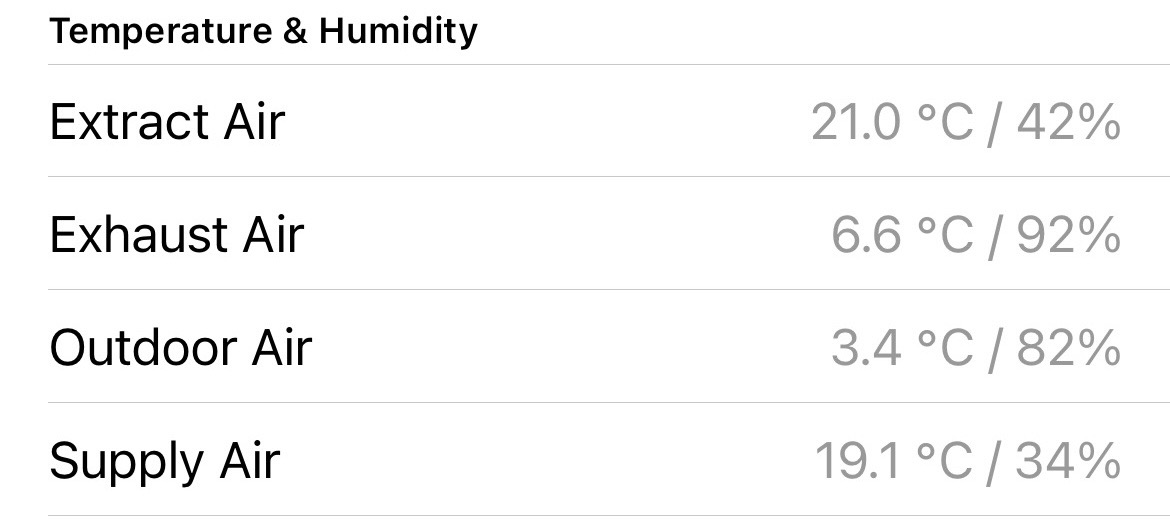
That is correct. My MVHR monitors 4 relative humidities, air taken into the system (Outdoor Air), air supplied to the house (Supply Air), air extracted from the house (Extract Air) and air expelled outside (Exhaust Air).
1 Like
Thanks, Tim. That’s impressive.
Zehnder ComfoAir 350Q
The figures on the screenshot don’t add up if you try converting humidities. That is because my condensate drain is flowing like a mountain beck.
Good stuff, thanks. Our indoor measurements are, temp= 18degC to 20.5degC (depending on which room etc) and r.h.= 45% to 65% ; would we expect sensations of dry skin and/or dry eyes in these conditions? Not that I’m thinking of denying what my partner has told me… just trying to understand it all, esp re. possible ASHP installation.
1 Like
45% to 65% is mostly in normal range, with 65% being above it. No, I would not expect any dryness conditions associated with the range in question.
However, everyone is different, so I suppose it’s possible. If you do deliberately increase humidity be aware of any cold corners or spaces out of normal circulation, such as fitted cupboards, and check for the first signs of mould. Not that it is likely at anything below 80% but cold areas will have higher humidity.
1 Like
My instinct is definitely against increasing indoors humidity because a) humidity is often fairly high already, and b) there have been some patches of black mould as humid air has hit cold areas, eg reveals of older, not-yet-replaced windows - this has been greatly reduced by the dMEV constantly extracting from the bathroom to outside, and c) in colder weather, higher indoors humidity can often contribute to (subjective) sensations of coolness. I think.
Humidity can magnify sensations of cold or heat, which is why British winters can feel colder than Swiss ones and jungles can feel hotter than scrubland at the same temperature.
1 Like
As winter has got cooler and the humidity in external air has dropped we have found that one room, the master bedroom, has developed a lower humidity during the day. This is less the case in other rooms but activity in those rooms may be adding the missing moisture.
The master bedroom does not feel dry to us with a humidity of 30% or less. In fact during overnight occupancy you can see the humidity rising from 27% to 31% and then falling again during the day. The room has an MVHR inlet valve.
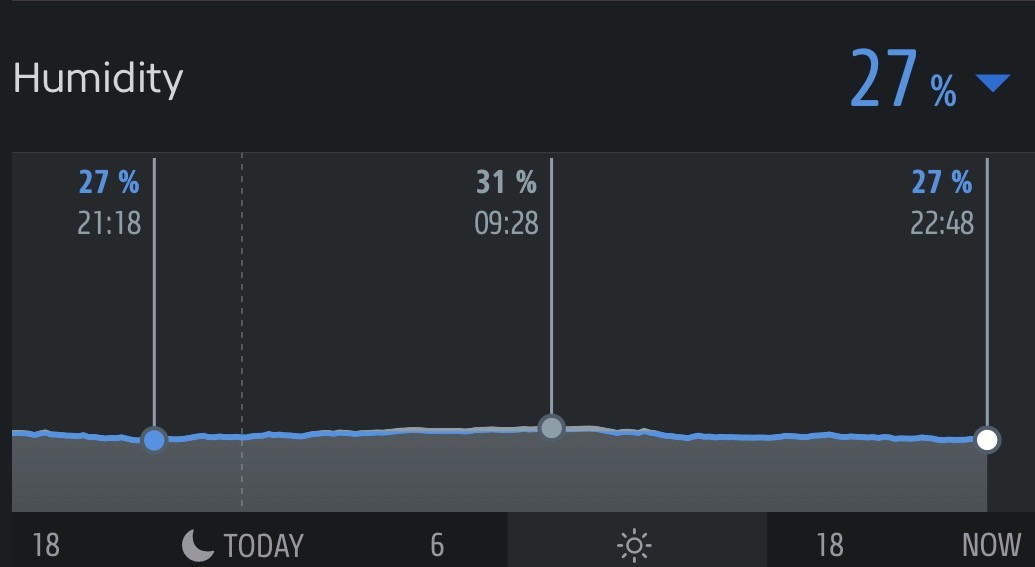
The MVHR humidity readings at the time of the above are
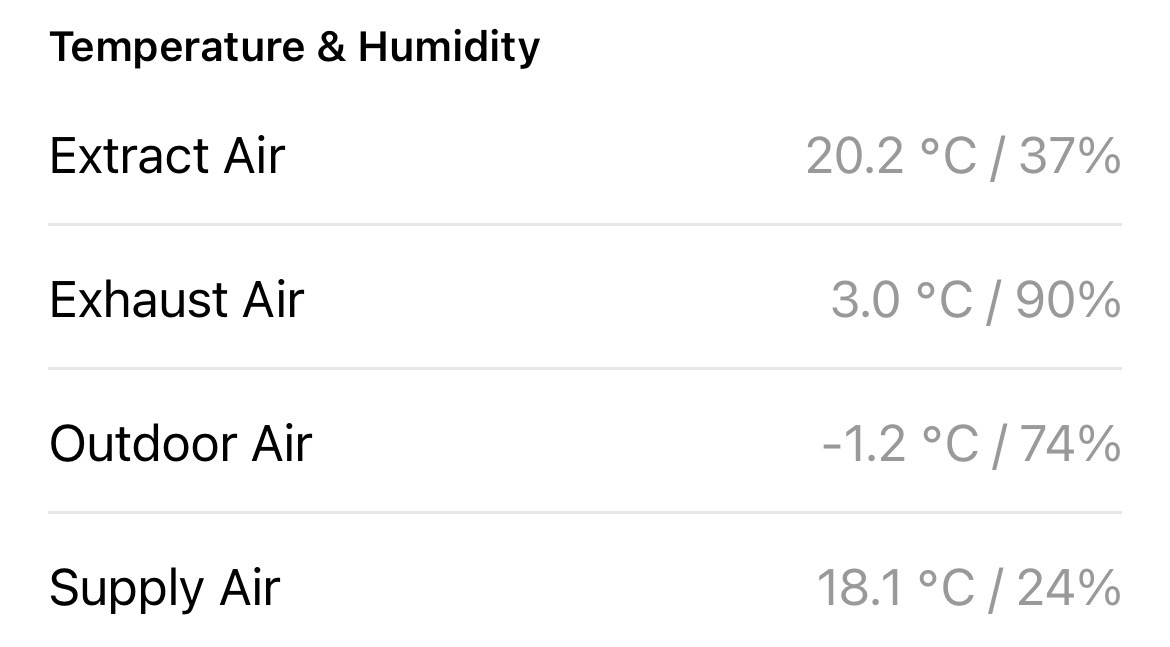
So external air is being supplied at a humidity of 24% and the average house humidity at extraction is 37%. No cooking, showers or baths are in progress. There are clothes drying but they are now adding very little humidity, having been washed overnight and been drying all day.
If the humidity, or lack of it, in your home is causing dry skin then an active humidifier may be needed. Mrs G and the children all use moisturisers but then African skin tends to be dry. If the dryness is irritating the airways it should be addressed urgently.
After considering various external shading options for the first floor I’ve decided that we have to go the internal route.
I visited the blinds-2-go website and found that I could enter a referral code. I presume that you have one if you can find it. Would you mind sharing on this forum?
I hope you get something for each person that orders using it.
Will check & get back to you
1 Like
Hi Tim,
We have no code as the purchase was made in 2021.
Apologies
Not to worry. It was just an off chance. It would have been nice for you too if you got rewarded for referrals.
Thanks for looking.
A thread on overheating seem a good place to post this research. In this forum we are probably well aware of the fabric side of things. I hadn’t realised that so many vulnerable people didn’t realise that they were vulnerable and that the symptoms of that vulnerability can include the inability to recognise situations that make them vulnerable. For example, elderly people often don’t feel the heat, so even without other vulnerabilities are more likely to be effected by it.
Being 70 years young puts me in a vulnerable category. I don’t feel vulnerable but I take all advice as if my life depended on it, just in case.
The CCC’s newly published report, A Well-Adapted UK, breaks new ground as it details what needs to be done to adapt the UK for the future climate. I though these quotes were useful, particularly for anyone able to include the measures in a planned retrofit.
The UK was built for a climate that no longer exists today and will be increasingly distant in years to come.
Creating at least one cool room in a house through low-cost active cooling could help avoid significant national-level increases in heat-related mortality if deployed in the 30% most vulnerable urban households. Further rollout could reduce mortality further and would also be cost-effective. Households and businesses will and should increasingly install cooling for their own comfort and productivity. Additional support might be needed to ensure that sufficiently effective cooling can be accessed by those who are both heat-vulnerable and low-income. Increased levels of active cooling can be managed alongside the transition to a reliable low carbon electricity system (as modelled in our advice on the level of the Seventh Carbon Budget). Heat pumps which provide both low-carbon heating and cooling could help to ensure this is achieved at low-cost and with minimal disruption, particularly for new builds.
The full report, which covers much more than the built environment is here:
https://www.theccc.org.uk/publication/a-well-adapted-uk/#a-well-adapted-uk
Re. overheating, don’t forget that a fair amount of this can come from roof surfaces, reason being they are lightweight, face the sun/sky more directly, and might not be insulated with dense enough insulation. Best if insulating roofs is to try and use denser insulation like wood fibre or hemp, in order to have some decrement delay (i.e. slowing down the rate of heat transfer during a heatwave day so that it doesn’t come right through to the room before it starts going back out again during the cooler night - see this doc for an interesting read: https://www.steico.com/fileadmin/user_upload/importer/downloads/imagebroschre_flyer_themenhefte/STEICO_Summer_Heat_Protection_GBR_en_i.pdf).
Thanks, Eric. It is most interesting to read about thermal diffusivity. I imagine it is somewhat analagous to moisture diffusivity, for which I have just searched online, and immediately found reference to Membrane Enthalpy Exchangers (MEE), at which point I retreated, not being familiar with much of thermodynamics (but I now see that enthalpy is essentially just energy, for most of our likely intents and purposes, and measured in joules, with which I am a little more comfortable). Moisture and thermal diffusivities are presumably the ‘hygro’ and ‘thermal’ parts, respectively, of the ‘diffusion’ part of the hygrothermal behaviour, and I have seen plenty of references to hygrothermal behaviour of buildings, but it is useful to see these two parts of it referred to separately.
I am a little wary of what seems like a bit of marketing obscurity in this Steico company brochure however, as they say that the outside temperature is 29 C at 20:00 in their example, when their right hand graph on page 5 clearly shows it to be 25 C, and they compare opening the windows at 20:00 with opening them at 1:00 am, by which time most of us are hoping to be fast asleep in our hopefully comfortable bedrooms. I am reminded too of the two-edged sword of thermal mass, which means if I understand correctly, that once a building has heated up during a hot spell it takes longer to cool down if it has a high thermal mass, all else being equal, which is undesirable, especially if night-time temperatures are not dramatically less than in the daytime, as is often the case in hot but cloudy weather. And other considerations, such as security issues or , may prevent one from leaving windows open all night.
Others on here may have more thoughts about all this, but it is all stimulating stuff. Thanks to you and also to our extremely regular contributors such as @Tim_Gilbert
I believe it’s all to do with the density of materials, be it Steico or whatever - generally wood fibre, hemp, grass, jute, straw, cellulose - in order to slow down the speed of heat transfer over a shorter period of time, as occurs between hot days and cooler nights. Eventually in a heatwave period, any house including the best insulated Passivhaus, will start to get warmer and will need windows opening at night to help purge excess heat - and yes it takes longer to cool down (in the same way that these take longer to cool down in winter). Alternative would be to have no insulation and have uninhabitable rooms in summer and winter with big temperature swings… I think it’s just building physics, can’t have perfect temperatures all the time and we have to manage those temperatures that we do have. If opening windows not an option, at least keeping windows closed during heatwave day time will help, then maybe even some portable AC could be an option I guess.
Avoid portable A/C if at all possible. It has a low COP, is noisy but worst of all it draws air out of the house, thereby drawing fresh, hot, air in through the house’s permeability. This warms the parts of the house receiving the air.
Yeah it should be last resort - need to stop heat coming in in the first place…