Sian, please share with us (me) how heatpumpmonitor is, or has been, helping you.
I am thinking of retrofitting the necessary monitoring kit in the hope of getting insights into my heat pump but don’t really know what I might get out of it.
Sian, please share with us (me) how heatpumpmonitor is, or has been, helping you.
I am thinking of retrofitting the necessary monitoring kit in the hope of getting insights into my heat pump but don’t really know what I might get out of it.
For me it’s mainly just for interest. I still check it daily, for learning to understand how the HP behaves through the year – mine’s at peak efficiency when outside temperatures are between 4 and 7 degrees, and runs continuously. Anything colder and the defrost cycles may kick in - dependent on humidity I believe. You can see what % of heat (or maybe energy?) has been used to defrost, worst case I’ve spotted is about 5-6% I think. Above 8 degrees and it starts cycling. A bit warmer and the pump switches off due to longer gaps between heating cycles.
My setup logs when the HP switches from heating to DHW and vice versa. That allows me to see the energy consumed and generated for DHW and heat separately. But I don’t have an extra cylinder sensor so can’t monitor DHW temperature other than via the Vaillant controls which I have found tricky to interpret.
As well as monitoring by Vaillant and Open Energy Monitor I also have tep and humidity sensors in each room linked to Home Assistant. It takes a lot of time to bring all data sourcces together into the ‘big’ picture.
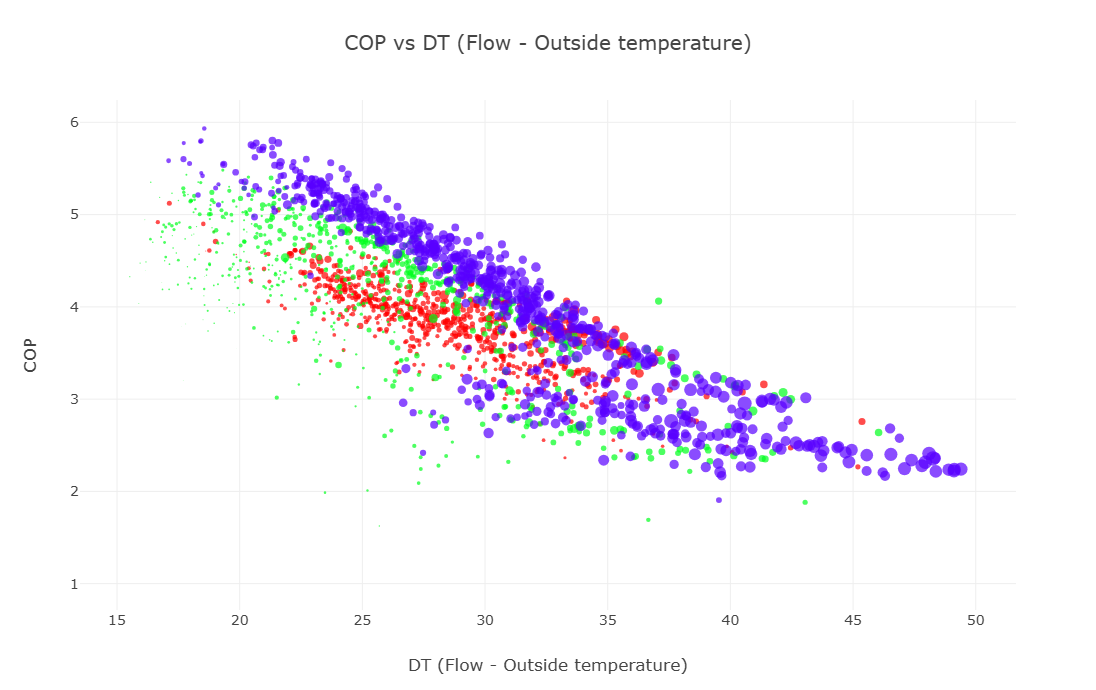
But I think there’s general agreement that the heatpumpmonitor stats are more accurate than manufacturer stats, and there are definitely good tools for analysis (although I haven’t really got to grips with those). So you may want to explore what’s available - my system is HeatpumpMonitor.org, and there’s a menu of options on the blue bar top rhs.
e.g. this is comparing my system (blue) with another two picked from the list.
The HeatGeek installer found it useful being able to visually check things in the first few months, and think he still checks that the system is performing to the guaranteed level occasionally.
Right from the start heatpumpmonitor was reporting errors during DHW cycles. Despite multiple attempts to get air out of the system over the first year, the errors crept back. The installer upgraded something (I forget what) to match latest best practice, and immediately those errors disappeared – something that manufacturer monitoring kit didn’t pick up on the errors so they would otherwise have gone undetected. I also had a problem with a cold radiator a year or so ago. Following a prior radiator balancing exercise, that valve was almost closed, and I checked that there no air in the radiator. It was only when I started looking at the flow rate on the display that I saw that it had been falling steadily over a period of weeks from the usual 20 to about 12. I think some crud had lodged itself somewhere in the system, but something was fixed, and I occasionally check the flow rate to make sure it’s as it should be.
Hope that’’s of some use!
Thanks. Very interesting. I now need to get an answer back from open energy monitor to find out how much the kit will cost and the cost of installing before I can guess whether it’s worth it for me. Obviously retrofitting will be a lot more expensive than if it had been fitted at installation.
I don’t have HA or similar, so can’t integrate with other sensors in the house.
As your heat hump starts cycling at such a low temperature it is probably oversized.
I was quoted £1000 to fit the kit with my ASHP install. Decided not too as the Vailant App actually tells you everything you need to know
The Daikin app doesn’t show COP or the figures required to work it out for myself. Neither does it show status readings for a whole range of things shown on the heatpumpmonitor web site. It doesn’t even have a boost button for a hot water cycle, only for an immersion one and even then it needs a manual switch off. Pretty but poor.
I’ve looked into the cost of parts and assuming that I don’t detect when a hot water cycle is running I can get the kit for £567.87^ (inc. VAT) plus the cost of fitting, which with both plumber and electrician involved will not be cheap.
Much as it goes against the grain to not seek top performance it would take me a very long time to save enough electricity to pay for the changes, particularly as the system will be off from end of April to maybe late September each year. During those months the solar thermal will provide adequate hot water.
^ Level 3 heat pump monitoring bundle (EMONHP) and metal DIN rail box