I received an email from International Passive House Association yesterday that I consider deserves a post in this thread. I’ve tried copying it here and hope it formats in a sensible way.
Passive House Fact Sheet
Number 37


At the International Passive House Association, we bring together leading Passive House experts to share practical knowledge on the topics that matter most in high-performance building design.
Our Fact Sheets offer concise, expert-driven insights into specific technical solutions, helping you stay informed, improve your projects, and apply best practices with confidence.
This issue focuses on multifunctional expanding tape for airtight window installation, highlighting how this innovative solution can simplify detailing while ensuring reliable airtightness.
All iPHA Fact Sheets are available as an exclusive benefit to members, who can access and download the full collection at any time.
Enjoy the read!
Multifunctional expanding tape for airtight window installation
In recent years, the use of multifunctional expanding tapes has increased significantly for the airtight installation of windows in new buildings and renovations. These tapes are applied around the window on three or four sides. They expand after installation, sealing the gaps between the window and the reveal. It is important that the reveals are sufficiently level and connected to the regular airtight layer with a smooth finish or adhesive.
These tapes are available for different gap widths and must be selected and applied accordingly (e.g. 8–12 and 10–15 mm). However, blower door measurements often reveal inadequate airtightness. Frequently, these tapes are incorrectly applied, even to the extent of completely useless double-layer application.
Studies conducted by the Passive House Institute in 2016 already showed that it often takes a long time (up to four weeks) for the tapes to show full effectiveness. It was also apparent that the gap width decisively influences on the airtightness of the tapes (report in German). Therefore, multifunctional expanding tapes should always be used close to the lower application limit. Even when a correctly applied multifunctional expanding tape has reached its maximum application limit, it often allows significant air flow.
According to its specifications, although the multifunctional expanding tape will be sufficient, it won’t be completely airtight. Specially reinforced multifunctional expanding tape, which is proven to have a high quality sealing effect, can be certified by the Passive House Institute as an airtight product for window connections.
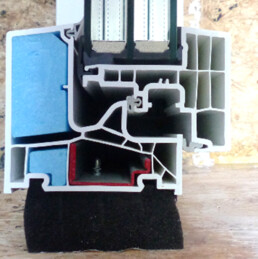
Image: Multifunctional expanding tape under a window frame (cross-section).
© Passive House Institute
Example project
In a large Passive House project, the windows were installed in smooth wooden reveals all around. In many cases, tape specified for gaps of 7 to 15 mm was applied to gaps with a width of 15 to 20 mm. The craftsmen used only this one product specified for a maximum thickness of 15 mm. When four windows were tested using an a-value measurement (airtightness of windows and installation), the average leakage was a considerable 2.2 m³/(hm) at 50 Pa. The target values are between 0.05 and 0.8 m³/(hm) (according to the Passive House Institute’s product certification). This high level of air permeability due to improper application would contribute 0.35 h-1 to the n50 value of the building. That would constitute a worryingly low tolerance for any further potential leaks.
Time-consuming subsequent work involving covering of the installation joints with conventional airtightness tape reduced this value to 0.57 m³/(hm). The share of window joints in the building’s n50 value was thus reduced to just 0.09 h-1, providing security against any unforeseen leaks.
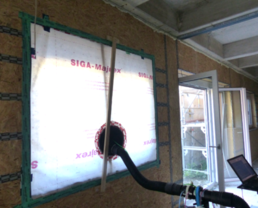
The Passive House Institute and other parties can carry out on site measurements to ensure the quality of installation work.
Measuring the airtightness of a window including installation joints.
© Passive House Institute
Explore All Fact Sheets
Authors: Wolfgang Hasper and Søren Peper, Passive House Institute
Fact sheet published in 2026
© iPHA / Passive House Institute
More info and sources:
www.passipedia.org
You can find all previously released fact sheets on Passipedia.
Fact-sheets in our knowledge database Passipedia
Contact
International Passive House Association
Passivhaus Institut
Rheinstraße 44 46
D-64283 Darmstadt
Tel: +49 (0)6151 82699-55
info@passivehouse-international.org
www.passivehouse-international.org