This seems as good a place as any, but definitely a topic which falls between what we class as Home Energy Systems and #people-powered-retrofit!
I am sure @matt is already up to speed on all of your monitoring data @sianrichards55 , but just in case he isn’t following this thread I have tagged him because it looks like there is some useful discussion going on.
How high was the damp?
How exposed is your location?
What is the orientation of the damp walls?
What external wall finish do you have?
What is the wall structure and age?
Anything else you think may be relevant?
I’m wondering if there is a reliable CO2 monitor that can be connected through Zigbee to a Raspberry Pi/ Home Assistant set up?
And separately, can anyone recommend a reliable portable CO2 monitor for gauging coronavirus exposure risk in offices, cafes and public places?
Hi Chris, I can’t vouch for the accuracy but there are hand held devices - a bit pricey. Have a look at RS components - they supplied a lot of kit to my old university department. https://uk.rs-online.com/ 174-6574
For the benefit of others, here are my top CO2 monitors for monitoring coronavirus exposure risk in offices/public places:
Battery powered
Aranet4 - £192 - NDIR sensor, visual display, +/-30ppm or 3% up to 5000ppm. Connects to app, data downloadable but bugs reported. Seems to one of two recommended for schools in Ireland. The Pro version connects to proprietary network ecosystem which is aimed at big building BMSs. https://aranet.com/product/aranet4-sensor/
UK sales: Aranet4 HOME Sensor | LOWEST UK Price £160 | Duomo (UK)
Vision - £129 delivered - NDIR sensor, visual display, mains powered, connects by USB for 30 days data download. Also recommended for Irish schools (no UK strategy in place yet!). ±40 ppm +3% @ NTP. https://www.vision-co2monitor.co.uk/
I’d agree with Chris, I’ve not found a reliable off-the-shelf zigbee CO2 sensor. In general detecting CO2 reliably is quite costly, it’s worth pointing out that the CO2 measure that @lloydham reported above (from the Foobot) is AI calculated from other sensors.
We’re looking at doing an in-person EcoHome Lab at Fab Lab Manchester, perhaps soldering and programming the Senseair S8 might be a suitable subject?
Matt (Fawcett)
Thanks Matt! It might also be worth mentioning that whilst we don’t have one which integrates well with HA @jonathan has been using this one in the office which does offer data logging capabilities and has been quite useful in informing our COVID safe-working policies.
I don’t have loads to add as I’m not that up on the technical integration of the meters. However, for reference, there is some great information on the CIBSE website relating to air quality, CO2 monitoring and COVID: CIBSE - Emerging from Lockdown
In response to this discussion we’ll be running a session on building the Airgradient sensors in Manchester on the 9th of December. The system uses the S8 sensor (as mentioned by @Chris_Carus above) for actual CO2 sensing, alongside a PM2.5 sensor, alongside total VOCs. There is a third party integration to bring all the data into home assistant. We will be doing a bulk order of the kits in advance, the cost of which will be between £50-60 - do get in touch if you’re interested.
Matt
You can either order your kit directly from Airgradient: https://www.airgradient.com/diyshop/ or contact me (matt@carbon.coop) to add your order to the group purchase. We’ll have to pay tax on the order from China which will push up the cost (inc VAT and shipping) to £63.67. There will also be free PCBs available on the night for those who’ve sourced their own parts.
We’ll have a unit already made up so that those not building can have a go at integrating it with Home Assistant etc. There’ll also be opportunity for a beer afterwards (it being Xmas and all )
Matt
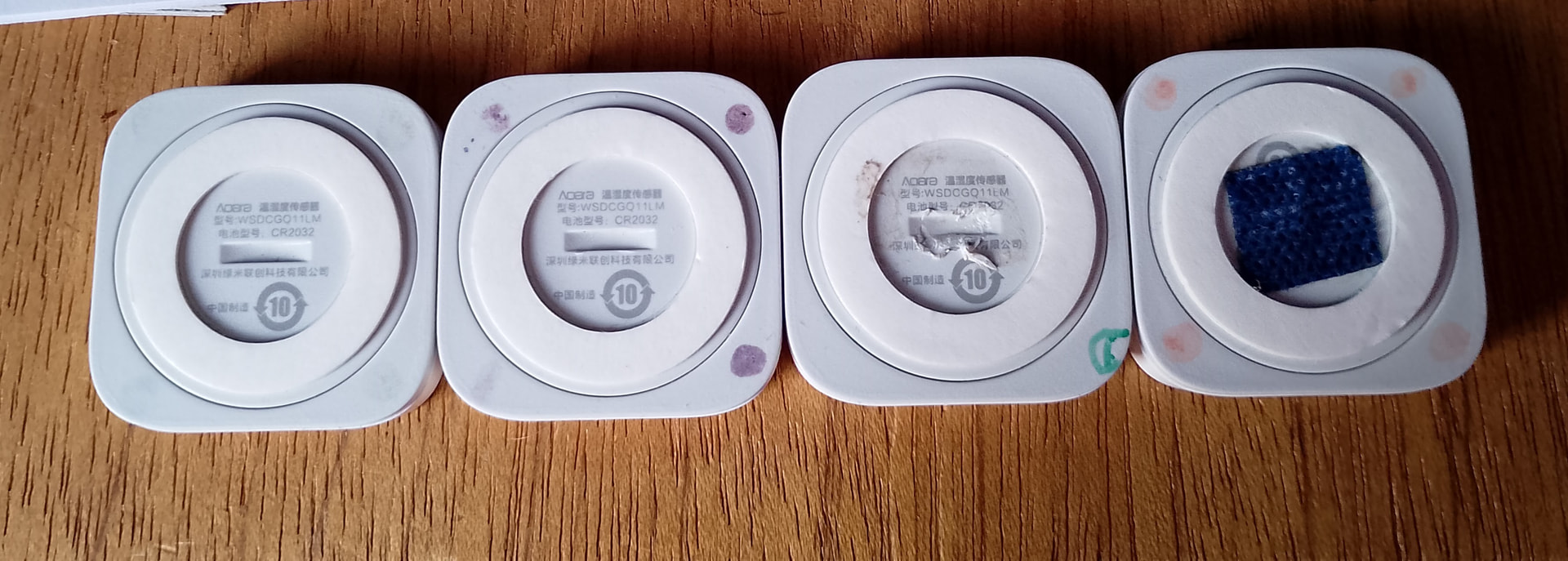
I’ve been monitoring temperature and humitity for years and now have a total of 11 sensors, one in every room, plus another 4 which I’ve had in various locations under the floor. I started off with SonOff sensors but they are failing over the years and being replaced one at a time with Aqara LUMI ones.
While the sensors are pretty reliable, I now have 4 sitting on my desk whose batteries need changing before they go back under the (now insulated) suspended floor. And I can’t open them to change the batteries - tried coins, screwdrivers, builders with strong hands - nothing works! I’ve even tried sticking rough faced airtightness tape on the back to provide more friction.
Has anyone else had this problem and found a foolproof technique?
I don’t use these sensors but have had issues with plastic screw threads binding. Try a LITTLE silicone spray. Do not use oil as it dissolves the surfaces of some plastics, resulting in a weld.
Thanks @Tim_Gilbert. I have some silicone spray so gave it a go. The coin still didn’t work. After wiping off as much of the spray from the back as I could and pressing down to turn I was able to remove 1 of the 4. So partial success .
Next I resorted to a bit of AI browser search assistance which found this - https://www.thedigitalpictureframe.com/how-to-change-the-battery-of-your-xiaomi-aqara-temperatur-sensor/. The trick was to remove the adhesive cover briefly stick them to a plastic surface, twist the sensor till the back was released, replace the battery, seat and twist the back to replace and prise off the plastic surface. Refit the adhesive cover.
Unfortunately I only got 2 of the 4 into pairing mode in order to connect to the ZigBee network. The ones that didn’t go into pairing mode had Duracell batteries, while those that did go into pairing mode have GP batteries! When I swapped out the Duracell batteries for GP ones they went into pairing mode first time, and all 4 sensors now successfully paired.
 ) so considerably cheaper than the others but its still an NDIR sensor and battery powered.
 )
)
 .
.